
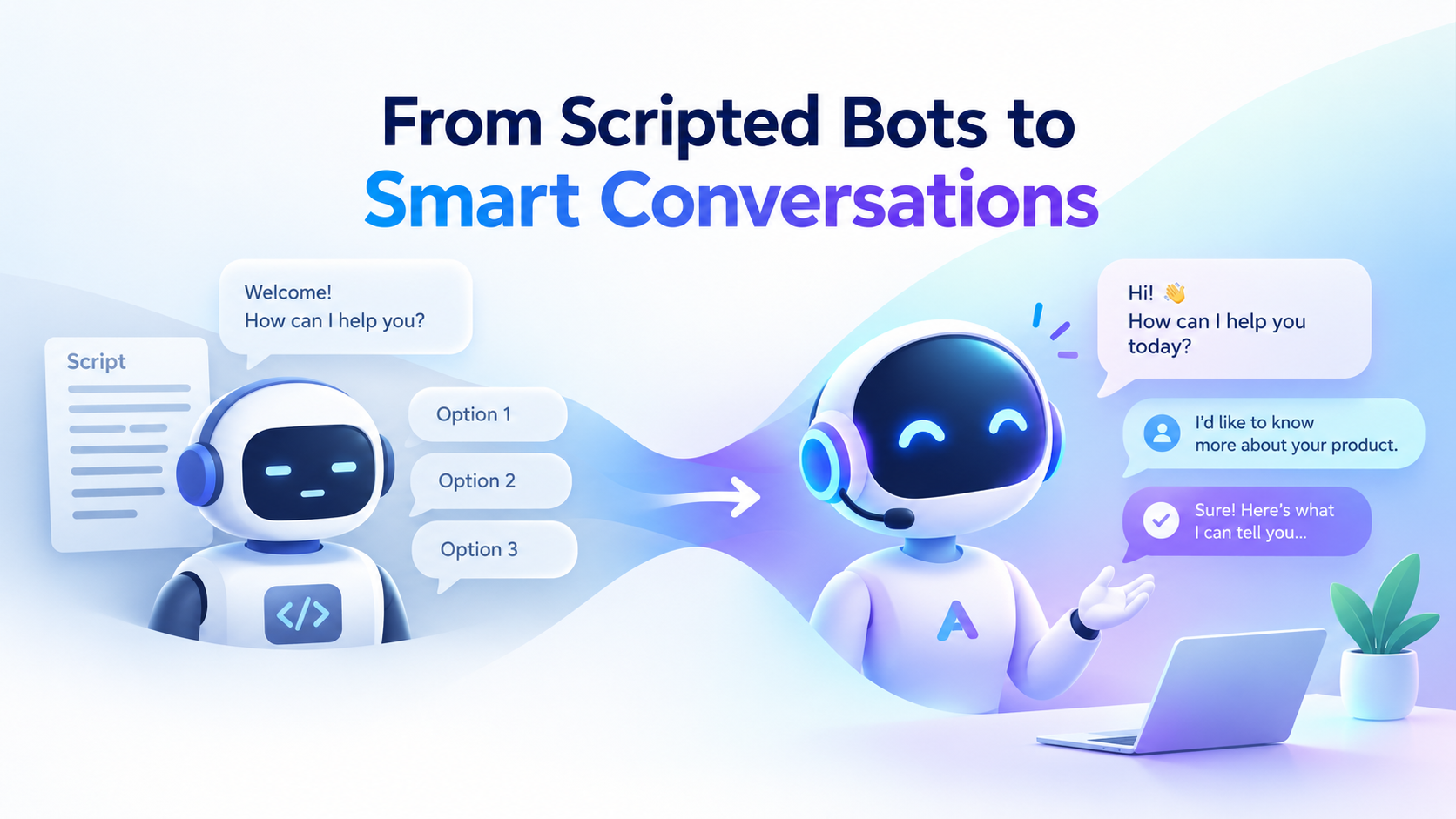
Customers no longer tolerate "Press 1 for sales" menus, canned replies, or bots that say "Sorry, I didn't understand that." They expect to ask a question in their own words, on the channel they prefer, and get a useful answer immediately.
That expectation is why conversational AI is outgrowing traditional chatbot platforms. Chatbots were a good first step, but they were built for a simpler era of customer interaction, and many businesses are now hitting their limits.
What Traditional Chatbot Platforms Actually Do
Traditional chatbot platforms run on decision trees, keyword matching, and pre-written scripts. A team maps out the questions customers might ask and writes a response for each one. When a customer follows the expected path, the bot works. When they don't, it breaks.
These platforms usually share a few traits:
- Rigid flows: Conversations follow a fixed script, so any off-script question causes confusion.
- Single-channel design: The bot lives on a website widget, and extending it to voice or email means building something new.
- Limited task completion: Most bots answer FAQs or collect a form and then hand the real work to a human.
- High maintenance: Every new product, policy, or offer means editing flows by hand.
What Makes Conversational AI Different
Conversational AI uses natural language understanding and large language models to grasp what a person wants, not just which keywords they typed. It handles interruptions, follow-up questions, spelling mistakes, and mixed-up phrasing the way a trained team member would.
Modern conversational AI doesn't stop at replying. It acts: it books the appointment, updates the CRM, qualifies the lead, sends the reminder, and escalates to a person when needed. The shift is from answering questions to completing work.
6 Reasons Conversational AI Is Overtaking Chatbot Platforms
1. It understands intent, not just keywords
A script-based bot looks for trigger words. Conversational AI interprets meaning. "I need to move my Thursday slot," "Can we reschedule?" and "Something came up, can I come another day?" all lead to the same outcome without anyone writing three separate flows.
2. It works across voice, WhatsApp, and email
Customers don't stay in one channel. They call, message on WhatsApp, and email, sometimes about the same issue. Traditional platforms treat each channel as a separate project. Conversational AI treats them as one conversation with shared context, so customers never have to repeat themselves.
3. It completes tasks end to end
A chatbot that says "Please call our support team" has handed the problem back to the business. Conversational AI books, updates, resolves, and routes. That is the difference between deflecting a conversation and finishing it.
4. It is available around the clock
Leads and support requests don't arrive only during office hours. Conversational AI responds in seconds at any hour, which matters because a lead contacted while still interested converts far better than one contacted the next morning.
5. It lowers cost without lowering quality
Hiring enough staff to cover every call, chat, and inbox at peak volume is expensive. Conversational AI absorbs repetitive, high-volume conversations, so your team can focus on complex, high-value ones. The goal isn't replacing people. It's using them where they matter most.
6. It is faster to launch and easier to improve
Older chatbot projects often take months of flow design and testing. Modern platforms train on your existing FAQs, documents, and tone of voice, so teams can go live in days. Built-in analytics on every call, chat, and email then show where to improve.
Where Conversational AI Delivers the Most Value
Any business that depends on high volumes of customer conversations benefits, but a few areas stand out:
- Sales and lead qualification: Respond instantly and pass only ready-to-talk prospects to your team.
- Customer support: Resolve routine queries about orders, fees, timings, and documents without a queue.
- Appointment booking and reminders: Reduce no-shows with proactive confirmations and reschedules.
- Healthcare, education, and financial services: Handle enquiry bursts, follow-ups, and feedback that teams rarely have time to do consistently.
What to Look for in a Conversational AI Platform
Not every product labelled "AI" delivers these benefits. When evaluating options, check for:
- Multi-channel support: across voice, WhatsApp, and email, with shared context.
- Real task completion: not just answers.
- Human handoff: that transfers the conversation with full context.
- Integrations: with your CRM, helpdesk, and calendar.
- Security and compliance: suited to your industry, including encryption and audit trails.
- Speed to launch: without heavy engineering work.
Platforms such as Aavtaar.ai reflect this shift. They offer voice, WhatsApp, and email agents that share one brain and one customer record, qualify leads, book meetings, and resolve support around the clock, with a human handoff built in when a conversation needs a person.
The Future Belongs to Conversations, Not Scripts
Traditional chatbots served a purpose, but customer expectations have moved past them. People want natural conversations, instant responses, and problems that actually get solved. Businesses want lower costs, faster service, and growth that doesn't depend on hiring in proportion to volume.
Conversational AI meets both needs. The companies that adopt it now won't just answer customers faster. They'll build a customer experience that scales.
Frequently Asked Questions
What is the difference between a chatbot and conversational AI?
A chatbot follows predefined scripts and keywords. Conversational AI understands intent, handles natural language, and can complete tasks across multiple channels.
Will conversational AI replace human teams?
No. It handles repetitive, high-volume work so people can focus on complex cases, and it escalates to a human with full context when needed.
How long does it take to deploy conversational AI?
Many modern platforms can go live in days, since they train on your existing documents and FAQs instead of requiring months of flow-building.
Is conversational AI secure?
Reputable platforms offer encryption, auditable conversations, and compliance-aware design. Always confirm the certifications your industry requires.