
AI agents have quickly gone from a novelty to a default expectation. Customers want instant answers on the phone, on WhatsApp, and in their inbox and businesses that can't deliver that risk losing leads to competitors who can. So it's no surprise that more companies are rushing to deploy their first AI agent.
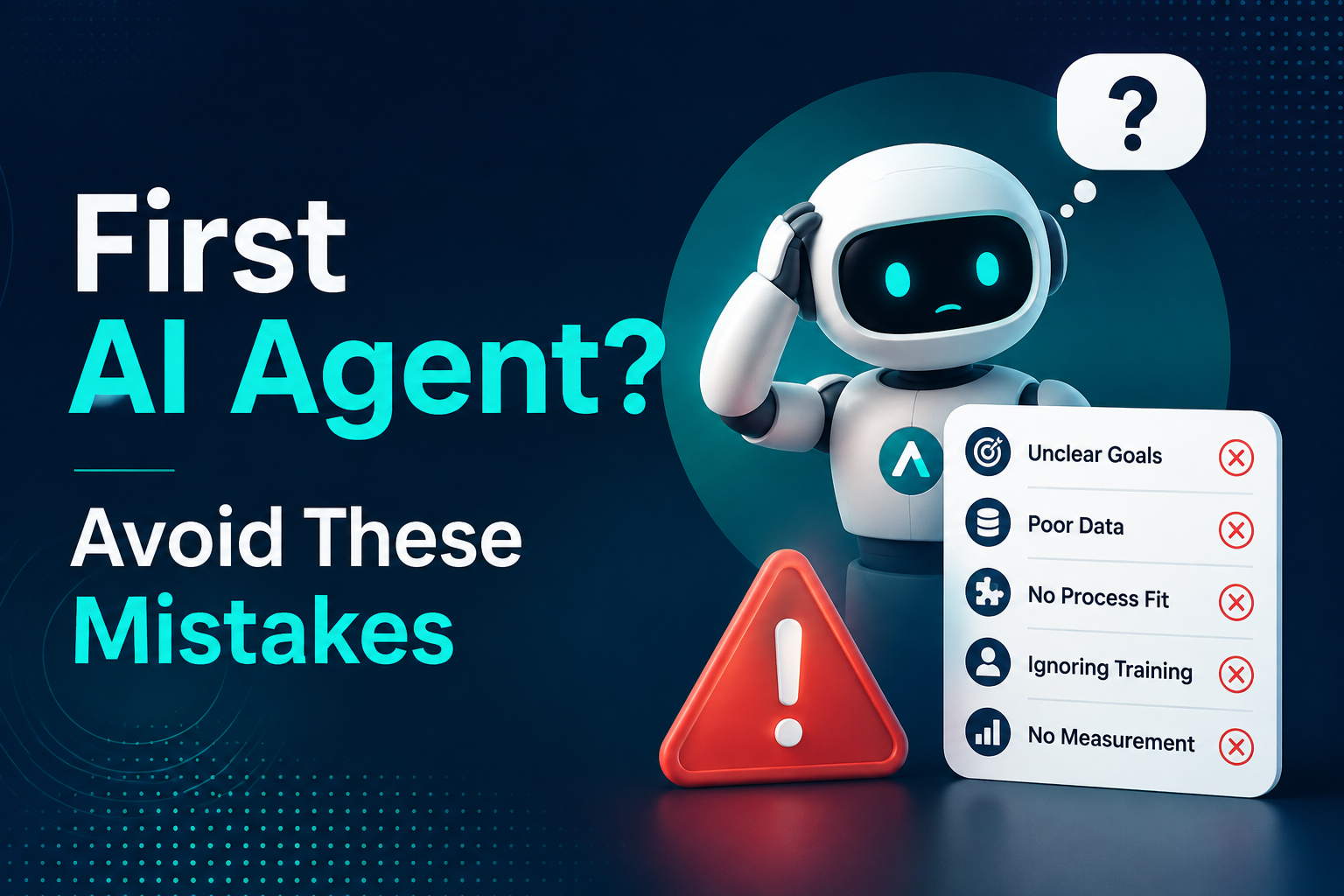
But "rushing" is exactly the problem. Most first-time AI agent deployments don't fail because the technology is bad. They fail because of avoidable, entirely human mistakes made during planning, training, and launch. If you're about to roll out your first voice, chat, or email agent, here's what typically goes wrong and how to sidestep it.
1. Treating the AI Agent Like a Chatbot Add-On, Not a Team Member
The biggest mistake businesses make is scoping their AI agent as an experiment on the side rather than a real extension of their team. A chatbot bolted onto a website with a handful of FAQ answers isn't the same as an agent that can actually hold a conversation, understand intent, and complete a task like booking an appointment or resolving a support ticket.
When businesses under-scope the project, they end up with an agent that answers questions but can't do anything which frustrates customers more than having no automation at all. Before deployment, define exactly what tasks the agent needs to complete end-to-end: qualify a lead, reschedule a booking, process a refund request, escalate a complaint. Task completion, not just conversation, is what separates a useful AI agent from a glorified FAQ box.
2. Skipping Clear Goals and Success Metrics
Many teams deploy an AI agent because "everyone else is doing it," without defining what success actually looks like. Is the goal to cut response time? Reduce cost per interaction? Free up staff for higher-value work? Increase lead conversion?
Without a specific goal, there's no way to measure whether the deployment is working and no way to catch problems early. Set 2–3 measurable targets before launch (response time, resolution rate, cost per interaction, lead-to-meeting conversion) and track them from day one.
3. Feeding the Agent Weak or Outdated Training Data
An AI agent is only as good as what it's trained on. A common early mistake is handing the agent a thin, outdated FAQ document or a knowledge base that hasn't been updated in years, then expecting it to sound like your best-trained employee.
Garbage in, garbage out applies here just as much as it does anywhere else in software. Businesses that get this right spend real time compiling accurate product details, pricing, policies, tone-of-voice guidelines, and edge-case scenarios and they keep updating that source material as things change.
4. Forgetting to Build in Human Escalation
Some businesses deploy an AI agent and assume it should handle everything, with no clear path to a human when a conversation gets complicated, emotional, or simply outside the agent's scope. This is where trust breaks down fastest. A customer stuck in a loop with a bot that can't understand a nuanced complaint will walk away angrier than if there'd been no automation at all.
The fix is straightforward: build clear escalation triggers sentiment, repeated failed attempts, specific keywords, high-value accounts so conversations transfer to a human instantly, with full context carried over. No one should have to repeat themselves after being handed off.
5. Deploying on Only One Channel and Calling It Done
Customers don't stick to one channel. They call, then follow up on WhatsApp, then send an email if no one answers. A common mistake is deploying an AI agent on just a website chat widget while leaving phone calls and WhatsApp messages to go unanswered, or worse, handled by a completely disconnected system.
This is one of the reasons platforms like AavtaarAi build voice, WhatsApp, and email agents on one shared brain instead of three separate tools so a lead who calls in the morning and messages on WhatsApp in the afternoon doesn't have to repeat themselves, and the business doesn't end up managing three disconnected automation projects at once.
6. Ignoring Guardrails and Compliance from Day One
Especially in regulated industries like healthcare, financial services, or insurance, businesses sometimes deploy an AI agent without setting clear guardrails on what it can and cannot say or promise. An agent that improvises answers about pricing, medical advice, or financial terms can create real liability.
Set explicit rules for what the agent is allowed to discuss, what requires a disclaimer, and what must always route to a licensed human. Guardrails aren't a limitation on the agent they're what makes it safe to scale.
7. Launching Without a Real Testing Phase
It's tempting to go from setup straight to full launch, especially when a vendor promises the agent can be live in days. But skipping a structured testing phase running real (or realistic) conversations through the agent before it touches actual customers is how embarrassing mistakes end up in front of paying customers instead of an internal team.
Run the agent through your worst-case scenarios: angry customers, vague questions, multiple topics in one message, requests it shouldn't handle. Fix what breaks before go-live, not after.
8. Not Reviewing Analytics After Launch
The final mistake is treating deployment as a one-time event instead of an ongoing process. Businesses set up their AI agent, watch it work for the first week, and then stop paying attention. But conversations evolve, new questions come up, and what worked at launch can quietly become outdated or inaccurate a few months in.
Review call transcripts, chat logs, and resolution rates regularly. Look for patterns in what the agent struggles with or where customers drop off, and use that data to retrain and refine it continuously.
Getting Your First AI Agent Deployment Right
None of these mistakes are really about the technology they're about planning, scope, and follow-through. A well-scoped AI agent with clear goals, solid training data, built-in escalation, and cross-channel coverage will outperform a rushed, feature-heavy one every time.
If you're preparing to deploy your first AI agent, the businesses that succeed are the ones that treat it less like a software install and more like onboarding a new team member one that needs the right information, clear boundaries, and room to improve over time.